2026 Aug. 17. - 2027 May. 7.
Recovery Society – Courses
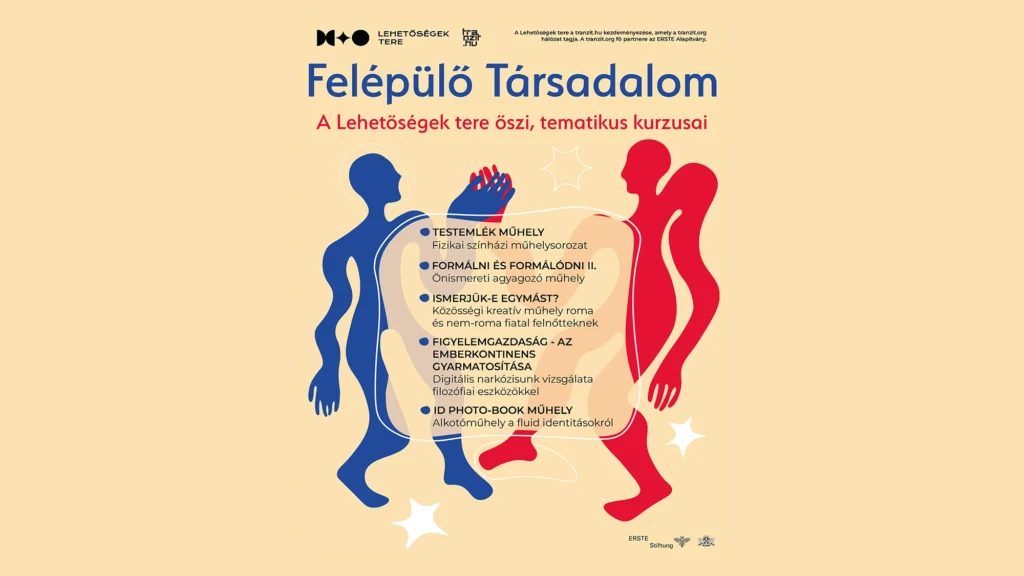
In the autumn of 2026, the Space of Opportunity offers informal training courses that rely on collaborative learning, self-awareness and creative methods
Regular events for those who are interested in community and art-based learning return to the Space of Opportunity in the second half of the year. The theme to frame this term’s programme is recovery society; we will explore the topic, both in its narrow and broad sense, at open discussions, community events and our autumn courses. The inspiration came from Recovery Culture, the PhD research project of Dániel Szalkai, a social designer and researcher, which will be the subject of an exhibition that opens in the Space of Opportunity in December.
Recovery societies support the recovery of people living with addiction with the power of community. The concept can be extended to broader societal processes that have an effect on individuals’ mental wellbeing, including the traumas caused by the regime in the past sixteen years; there is a need to recover from unresolved conflicts, political division, disregard for the real needs of society and the absence of institutional solidarity.
The informal courses, where participation is subject to registration, focus on community learning, self-awareness and creative methods. On 19 September, at our Autumn Opening get-together, the leaders will preview their courses to help those interested in choosing the right programme.
Body Memory Workshop
Physical theatre workshops
Duration: 13 sessions between September 21 and December 18, 2026, on Mondays, between 5:00 pm and 7:00 pm
Course leader: Ágnes Sarlós, movement theatre trainer
A talking point.
A story, fairy tale or folk song from your childhood that you’d like to share.
And your body, which remembers it.
The Body Memory Workshop offers opportunities for inner explorations, collectively and individually, through the means of physical theatre and theatre therapy. Instead of being carried on by words, the stories brought by the participants are shaped through body language, movement, sounds and presence. This course links to the theme of ‘recovery society’ through the sharing of individual memories and experiences. It explores how we can be present together with different stories, feelings and viewpoints, how we can listen to each other and how we can draw on our differences and build a joint experience, a shared space. The course culminates in a performance jointly created by the participants.
Shaping and Being Shaped II
Self-reflective pottery workshop
Duration: 6 sessions between September 30 and December 2, 2026, on Wednesdays, between 5:30 pm and 7:30 pm
Course leaders: Anna Horváth and Dóri Szabó, programme organizers
Shaping and Being Shaped is a workshop where we work with clay to explore different concepts and life situations. The approach allows participants to slow down, observe and reflect on their internal processes. The six sessions address different aspects of individual and societal recovery. We will adopt an attitude of ecological awareness as we approach everyday experiences, and we will examine concepts like regeneration, de-growth and care. We will regard recovery not as an end in itself, but as a process of continuous development and inner exploration, for which clay offers a particularly compelling medium, thanks to its moldelability and capacity to be reshaped.
Do We Know Each Other?
Creative workshop for young Roma and non-Roma adults
Duration: 6 sessions between September 3 and November 28, 2026, on Saturdays, between 3:00 pm and 7:00 pm
This series of workshops is jointly presented by the Space of Opportunity, Bura Gallery and the UCCU Roma Informal Education Foundation.
The course invites Roma and non-Roma participants to learn, reflect and create together. Participants will be introduced to the history of the Roma in Hungary, including the Roma Holocaust and its consequences for society, which reverberate to this day. We will adopt intersectional perspectives to understand how structural racism operates; in other words, we examine how discrimination arises from the complexity of ethnic and social inequalities. Through the work and perspectives of Romani artists, we will focus on Romani women’s perspectives and Roma Futurism. We will tackle the subjects in interactive sessions, on a walk through Józsefváros, at a Roma stand-up comedy event and through joint creative work.
This programme is supported by the Municipality of Józsefváros, the 8th District of Budapest.
Attention Economy – The Colonization of the Human Continent
A philosophical investigation into our digital addiction
Duration: 5 sessions between September 7 and December 9, 2026, on every second Wednesday, between 6:00 pm and 9:00 pm
Course leader: Leonárd Máriás, philosopher
The Space of Opportunity’s philosophy circle is back as a course! Entitled Attention Economy, this course—which we hope will be more like a workshop for collective thinking—concerns itself with concepts and phenomena that help us towards a better understanding of the mechanisms that drive the digital world. This world has become so deeply woven into the fabric of our personal and social lives that one might even say there is scarcely a moment in life that does not belong to, or is not connected in some way to, cyberspace. The subject is important not only because this is something that shapes our lives in significant ways, but also because our set of concepts is very limited, which hinders our ability to navigate this new, rapidly changing world.
ID Photo-Book
Making a photo-book about fluid identities
Duration: 10+1 sessions between November 26, 2026, and May 7, 2027, on every second Thursday, between 5:00 pm and 8:00 pm
Course leader: Zsófia Puszt, photographer, critical art mediator
The fourth Photo-Book Workshop links to the autumn theme of the Space of Opportunity by reflecting on subjects that have been marginalized from public discourse and made taboo over the past sixteen years: the search for identity, self-identity and inclusion. Photography and artist books will be our tools at this workshop, and a safe creative environment will be ensured by the presence and support of mental health professionals. The process fosters self-awareness, critical thinking and the emergence of a community. The aim of the programme is to encourage members to engage in creative self-expression, dialogue and openness.