Sep. 25.
Zoom In – Aliz Farkas: We Are Still Here
tranzit. hu launches Zoom In, a public art project that thematizes issues barely discussed or marginalized from the spaces of the public sphere. The title refers both to the focus of the content—subjects that have been left undiscussed or marginalized—and to the local embeddedness of the project: the resulting works will be displayed at various locations in Józsefváros, the 8th district of Budapest, where tranzit. hu has been operating for more than seven years. This year’s edition marks the pilot phase where we have invited artists to realize new projects, whereas from 2027, we will request visual artists’ applications through open calls.
Issues relating to the public sphere have featured prominently in the work of tranzit. hu over the past 20 years. As a parallel institution engaging in critical art, it addresses issues that are often outside the remit of the existing institutions of art and education. It is of paramount importance to democratize access to art just as it is to ensure active, participatory engagement in social issues, and to posit the interpretation of art as a form of critical thinking and learning.
The Zoom In project places these questions in the context of the public space, the medium perhaps best suited to amplifying things or making them visible. While it provides a platform for various forms of expression, public space also serves as a litmus test for society, highlighting current problems; it is not only a venue, but also a source of content.
Local embeddedness is an important characteristic of the project: the Space of Opportunity, a community and art space launched by tranzit. hu in 2021, operates in the 8th district. One of the main focuses of our work here is to explore the immediate urban environment through art projects and to collaborate with residents in the neighbourhood; this context engendered the plan for a public art project based on community involvement. The 2027 open call for proposals will aim to support cooperation with local groups and communities.
This year is a pilot period whose theme is the ephemeral present moment in Hungary, the hopes sparked by the current political change: we encourage the creation of artworks that embody the possibilities of solidarity, imagination and planning anew. We are attempting to reclaim public space, giving a platform to stories, issues and the voices of social groups that were all but barred from attending in the public discourse over the past 16 years, under a soft dictatorship of the Orbán era that disguised itself as democracy.
For the pilot period, artists Aliz Farkas and Norbert Oláh have been invited to create public space works.
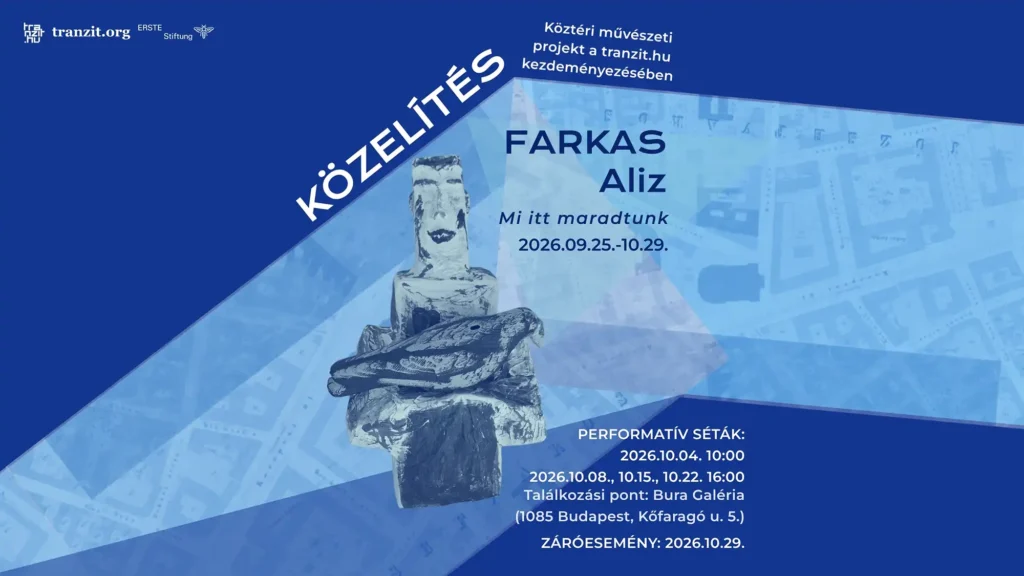
The first project is Aliz Farkas’s series of performances, We Are Still Here, with the first event taking place on September 25, 2026.
Project leaders: Judit Árva, Dóra Hegyi, Regina Sárvári
WE ARE STILL HERE
Concept: Aliz Farkas
Featuring: NF Sándor Bán, Csilla Horváth / HoCSi, Tünde Jordán / Czoboly, Szamócza
We Are Still Here is a participatory art project that lends visibility to the subject of housing poverty. The project is based on a concept by Aliz Farkas and involves artists who are homeless or live in housing poverty. The inspiration and starting point were the single-occupant seats on Blaha Lujza Square, those prime examples of hostile design,* and the spontaneous sit-in of homeless people in the underpass of the same square that was carried out in the winter of 1989. The project evolved organically over the course of a month’s group work; the collaboration shaped both its content and its form.
During the workshops, the artists created human figures from waste materials, and complemented them with inscriptions, drawings and paintings—the thoughts of people who have experienced the drift to the margins of society, or were actually born on them. ‘Down, up and all around, there lies infinity,’ says the inscription on one of the figures. Instead of activist slogans that may easily become hollow, the works embody real lives, without revealing them in their entirety. The figures render the experiences on the margins now in a playful manner, as if they were episodes of fables, and now in a dark tone.
The invited contributors are people who are affected by various aspects of housing problems and whose creative works—poems or drawings—have been featured in Fedél Nélkül [Without a Roof] magazine.** During their collaboration, Aliz Farkas applied Fohno,*** a method she had developed earlier, which allowed the group to jointly shape the concept, while getting to know each other’s thoughts and stories.
The project took the form of workshop–based gatherings and was underpinned by the following questions: How can we create an environment in which the invited creative partners can speak in their own voices, instead of us speaking on their behalf? How to make visible the experiences of those for whom ‘outside’ means, or once meant, the everyday space of life? How can we overcome the persistent separation between public space and individual problems?
The project includes public performances, talks and guided walks between September 25 and October 29, 2026. The format ties in with one of the concept’s key messages: since public space holds up a mirror to the issues of society, the works are presented in a dialogic situation—rather than simply being displayed—reinforcing the validity and visibility of each other’s ideas.
As we carry around the figures, we jointly convey the message of those whom we tend to overlook amidst the waves of changes and proposals—those who are still in the square.
Events of the project:
September 25, 2026, 5 pm – Opening performance and discussion. Meeting point: Space of Opportunity
During the September 25 performance, we join the artists involved in the project, and carry the human figures on our backs as we walk from the Space of Opportunity to Blaha Lujza Square. As part of the performance, we will temporarily place the figures in the square. The event will conclude with an informal discussion, during which participants can ask the artists questions in small groups.
Performative walks:
October 4., 10 am
October 8., 4 pm
October 15., 4 pm
The performative city walks are jointly led by representatives of the Első Kézből a Hajléktalanságról [First-hand on Homelessness] programme and the involved artists.
Each walk starts from Bura Gallery (1085 Budapest, Kőfaragó u. 5)–where participants pick up the figures–and return there. The duration of the walks is approximately 2 hours.
Route: Bura Gallery – 32-esek tere – Menhely Foundation, Vajdahunyad u. – Józsefváros District Municipality – Weiss Manfréd Soup Kitchen (Baross u.) – Szigony utca–Baross utca intersection – Koszorú utca: Transitional Home for Families, LÉLEK Point, and a former illegal shelter – Mátyás Square – Rákóczi Square – Blaha Lujza Square – Bura Gallery
Participation requires registration and payment of a participation fee. Registration is possible via this form. The fee is 3.000 HUF per person, with which participants support the work of the First-hand on Homelessness programme. The participation fee can be paid on site, in cash, at the start of the walk.
October 29, 2026 – Closing performance and discussion. Meeting point: Bura Gallery
* Hostile architecture is an approach in the design of urban architecture that deliberately makes certain elements of public spaces—such as chairs, benches, larger surfaces intended for sitting—uncomfortable or unfit for purpose, so as to control, and in some cases prevent, their use.
** Published by Menhely Foundation, Hungary’s first street newspaper provides work and independence for its authors, editors and distributors, who are homeless or live in extreme poverty.
*** Fohno is both a method of cooperation and a network: the participants of a project can shape the concept with their own voices, while the principles remain unchanged. Its aim is to create an open, accessible space where people from different backgrounds can work and create meaning together.
https://fohno.com/