WorldWide Club – Convo Night
A facilitated speed-mingling for internationals and English speaking people

Looking for an effortless approach to making real connections? This is the right space of opportunity for you.
🌍 WorldWide Club Launches March 11 at Lehetőségek Tere 🌍
WorldWide Club is the first time at Lehetőségek Tere for international students and any other English speaking people to make connections and share perspectives in a speed-mingling, where participants change thematic discussion tables and groups in a casual environment. It’s a space to connect, share perspectives, and build a truly international community.
Date: 11 March, 2026, 18.00-20.00
Venue: Lehetőségek Tere (1083 Budapest, Práter str. 63.)
At WorldWide Club, you can:
✨ Be vulnerable without judgment
✨ Grow personally through meaningful conversations
✨ Connect with people from diverse backgrounds
✨ Widen your perspective
✨ Share opportunities with peers
CONVO NIGHT
During the one-hour discussion session, you’ll rotate in small groups (3–5 people), exploring topics ranging from lighthearted icebreakers to deeper, thought-provoking conversations.
How it works:
👉 Choose from a list of topics you’d like to explore
👉 15-minute discussion rounds, then rotate groups
👉 Meet new people and exchange perspectives throughout the evening
👉 Snacks and open mingling at the end
💡 Topics may include quizzes, icebreakers, philosophical questions, controversial debates, and psychological games.
Apply here: https://docs.google.com/forms/d/e/1FAIp
🗓️ If this session goes well, we’ll make it a monthly event.
🎯 You might walk away with new contacts in your phone — but sharing details is completely optional. No pressure, always your choice.
Come as you are. Leave with new perspectives! 👁️
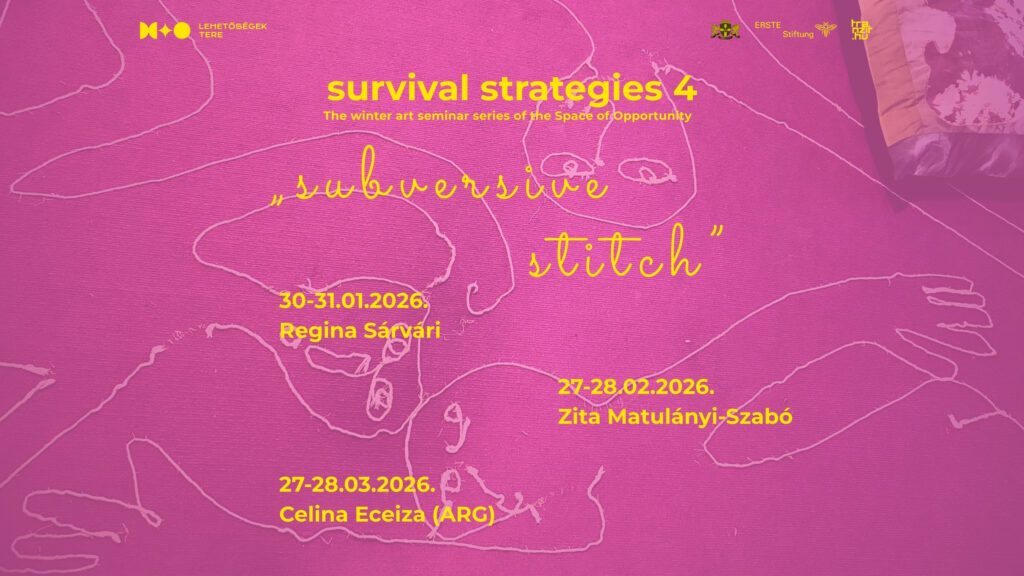
The fourth part of our Survival Strategies, the winter art workshop series of the Space of Opportunity, will be centred around the concept of the ‘social fabric.’
For a long time, making textiles and needlework were considered occupations or a form of folk art practised exclusively by women. The 1960s and 1970s saw an increasing number of female artists question this attitude and adopt textiles or various forms of needlework as the chief medium of their messages. While forgotten female oeuvres are being rediscovered and using textiles has become a vital trend in art, the form has not been widely acknowledged or admitted to the artistic canon.
When it comes to the collective traditions of working with textiles, the spinning rooms in the villages were the most important places for non-urban social life in wintertime up to the advent of modernization in the 20th century. In addition to being opportunities for working in company and for passing on skills (spinning, weaving, embroidery) from one generation to the next, these occasions were also important for the cultivation of connections, the exchange of information and entertainment – including for the men who dropped by. While the modern lifestyle has mostly deprived needlework of its usefulness, women’s activist groups around the world keep rediscovering this tradition – often in archaic women’s communities – and use it as a means of community action against social injustices.
The expression, ‘social fabric’ likens the structure of society to that of a textile composed of threads. The threads that make up this fabric are the institutions that define the confines within which society can or must function, as well as the invisible connections, norms and unwritten rules that hold it together. This year’s programme focuses on the socio-cultural environment that shapes identity, as well as on the need for collective care and protective spaces. The textile- and needlework-based methods introduced by the artists we have invited will allow participants to represent personal and collective stories. The sessions are also meant to facilitate the creation of momentary or permanent communities through the act of collective creation. You do not need any experience in needlework to participate in the workshop; we will create a space where anyone can work with textiles, regardless of their gender/affiliations/interests.
(1) The title refers to a 1984 book by British feminist art historian Rozsika Parker, in which she shows how, historically, needlework has been associated with femininity and the role of the passive housewife, and how, from the 19th century onwards, it became a means of resistance and self-expression for women.
Details:
The program consists of the artist’s Friday evening presentation (public and free) and a Saturday workshop (registration required, participation fee applies).
Three occasions: 21.000 Ft
One occasion: 10.000 Ft (For students: 5.000 Ft)
Registration: https://forms.gle/sVsEf4t4tYfFjE8z8
Application deadline for the first session: March 23, 2026 (midnight)
If paying the fee is a challenge for you but you would still like to participate, please contact us at office@lehetosegektere.hu.
1.
January 30, 2026, 18.00 – 19.30 Presentation by Regina Sárvári
January 31, 2026, 11.00 – 17.00 Workshop with Regina Sárvári
The Political is the Personal
The workshop is based on the idea that „the personal is political,” a slogan that became widespread during the second wave of feminism. It expresses the belief that women’s personal experiences are shaped by their political situation and by gender inequality. Housework, childcare, and care work – often seen as part of private life – are in fact forms of labor and matters of public concern. The fact that this work, usually done by women, is not properly recognized, reveals that society functions unequally and that oppression is built into social systems.
Taking this well-known slogan and applying it to our present situation, we can also turn it around and say: „the political is the personal.” In this sense, the phrase refers to the way a hostile, patriarchal, and sexist political environment affects and crosses borders to our private lives. In the workshop, participants work with political and public statements that we hear in everyday life. These statements negatively shape our personal lives, emotions, career paths, life goals, gender and social identities, and the rights connected to them. They include widely quoted slogans by politicians and provocative messages of political propaganda, such as „No migration. No gender. No war.” or „Hungary is moving forward! Not backward.” Using irony and humor, we give new meanings to these texts, which often spread fear and reinforce oppression. In a safe and supportive community, we will sew these phrases onto our own personal and intimate items: our underwear. By placing these political messages onto our underwear, we appropriate and take control of the statements that invade our private sphere. Through this process, we reinterpret, disarm, and empty these phrases of their power, symbolically turning them to our own benefit and releasing the frustration they cause.
What to bring?
Please bring at least one item of underwear on which you will sew a chosen text during the workshop.
Who can take part?
The workshop is open to everyone, regardless of gender or gender identity.
Regina Sárvári is a visual artist and cultural worker. She graduated in 2024 from the Intermedia Department of the Hungarian University of Fine Arts. Since then, she has been a member and a board member of the Studio of Young Artists’ Association (FKSE). In her artistic practice, she explores various social, political, historical, and ecological issues through artistic research. She works across different media and techniques, including photography, video, performance, and textiles. Collaboration is central to her practice, as well as collective thinking and creation, and horizontal knowledge sharing.
2.
February 27, 2026, 18.00 – 19.30 Presentation by Zita Matulányi-Szabó
February 28, 2026, 11.00 – 17.00 Workshop with Zita Matulányi-Szabó
„In Sheep’s Clothing…”
‘In Sheep’s Clothing’ is a workshop that explores issues of growing up, finding your way and developing your identity, both on a personal and social level. The event is aimed at participants who are open to reflecting on and creating art about these topics through their own experiences, memories and inner narratives. The question of coming of age appears in almost every culture: in fairy tales, myths, religious stories and literary parables. Examples include Parsifal’s journey, the story of the Prodigal Son, initiation rites or folk tales in which the hero sets out on a journey, faces trials, gets lost, encounters helpers and adversaries and then – seemingly – arrives at his destination. In these stories, the path is never straight and learning often takes place through loss, mistakes, failures or recurring cycles. The question arises: is there even a particular point where we ‘become adults?’ Is there a clearly defined line, or is growing up instead a continuous, circular state to which we return again and again at different stages of our lives? What events, breaks, decisions or setbacks are associated with this journey, and how does our self-image change in the process?
Instead of offering definitive answers, the workshop seeks to encourage collective thinking about these transitions: the departures, setbacks, returns and identity changes. About those moments that are often associated with powerful symbols – in the form of objects, phrases, physical sensations, memories or inner images. During the session, we specifically attempt to examine how ancient tales, stories, symbols and metaphors can be transposed into the individual lives and personal journeys, and what parallels can be discovered between collective narratives and individual experiences.
During the session, participants will create individual felt patches using wet felting and needle felting techniques. These works can be interpreted as personal statements or self-reflective impressions. In this context, the patch is not merely a decorative element, but a portable sign: a form that condenses an inner state, thought or attitude into an image and something physical. For everyone, the point of departure will be their own subjective system of symbols, so the finished works can be abstract or figurative, instinctive or consciously shaped.
Before we set to work, we will have a joint discussion, with some help from the questionnaire distributed in advance. The questions touch on the themes of finding one’s way, growing up, gaining independence, returning to the family and identity, giving each participant the opportunity to reflect on their own story, in advance and, if they so wish, to incorporate it into the process of collective thinking and creation.
Zita Matulányi–Szabó intermedia artist lives and works in Budapest. Her works combine the symbolism of religious stories and folk tales with personal narratives. Her artistic practice is based on the processing of family and relationship dynamics, as well as physical symptoms, illnesses, and stories of healing. She works with video performances, used textiles, wool, and various felting techniques, switching between media with self-evident ease. She places traditional textile techniques in a contemporary context, while consciously deconstructing and rearranging their layers of meaning.
https://szabozitaszabo.myportfolio.com/
3.
March 27, 2026, 18.00 – 19.30 Presentation by Celina Eceiza
March 28, 2026, 11.00 – 17.00 Workshop with Celina Eceiza
“Drawing: the oldest, the most modern, the most difficult, and the cheapest means of expression in the world.”*
This statement, articulated in 1979 by América Sanchez (Buenos Aires, 1939) and Norberto Chaves (Buenos Aires, 1942 – Barcelona, 2024)—two Argentine designers, educators, and drawing enthusiasts living in Barcelona, who that same year wrote Promoción internacional para el estudio y la práctica autodidacta del dibujo (International Promotion for the Study and Self-Taught Practice of Drawing)—provides the conceptual framework for this workshop.
Is it possible to identify a practice shared by all human beings? While not universally cultivated, drawing is arguably one of the most widely experienced forms of expression. At some point, most people have used a pencil to sketch, trace, or doodle in order to communicate something that exceeded the limits of language.
Over time, drawing often becomes associated with skill, talent, or specialization, leading many to abandon it. This workshop challenges that assumption. It begins from the premise that drawing is not a matter of expertise but of gesture: a fundamental human capacity grounded in the movement of the hand.
No prior experience is required. We will approach drawing from its most elementary dimension — as a physical act that produces marks in space. By foregrounding gesture over representation, the workshop seeks to reposition drawing as a shared and accessible practice.
Participants will collectively construct a temporary textile architecture that functions both as environment and medium. The space itself will become the surface for inscription. Windows and doors will be outlined, baseboards will host small-scale interventions, and the soft walls will receive marks that extend according to the reach and scale of the body. Through these actions, drawing will operate not only as image-making but as spatial articulation.
Working collectively also introduces critical questions: Where does one gesture end and another begin? How is authorship negotiated on a shared surface? What forms of responsibility emerge when drawing becomes a relational act? Rather than conceiving drawing as imitation or reproduction, this workshop proposes it as a practice through which shared space is constructed and negotiated. The site of the workshop, located in direct contact with the street, further expands this inquiry. It invites consideration of permeability between interior and exterior, and raises the possibility of extending the drawing beyond the confines of the workshop space, engaging passersby as potential participants.
In this sense, drawing is approached not merely as a technique, but as a collective practice that redefines space, authorship, and participation.
*https://clubdeldibujo.com/…/09/01-CdD-Sanchez-Chaves.pdf
Celina Eceiza is an artist and writer, who lives and works in Buenos Aires. In her installations, created mainly from hand-made textiles, space is conceived as a metabolic organ, capable of absorbing and processing different physical and psychological states, as well as various practices, beliefs, desires, and rituals. In the words of curator Jimena Ferreiro: „Celina Eceiza’s installations invite you to partake in pleasant, porous and expansive environments. Constructed as if they were states of mind, these spaces yearn to be experienced by a body that forgets its rational nature and gives way to the pure will of sensitive knowledge. This intimate and, at the same time, collective experience displays its political power by presenting art as a living form that must be nurtured in order to reveal new possible links between humans.”