Event

<
>
Mar. 11.

WorldWide Club – Convo Night

A facilitated speed-mingling for internationals and English speaking people
18:00 - 20:00
2025 Mar. 15.

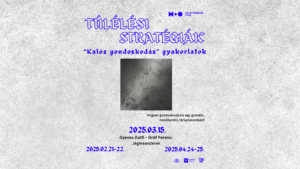
Survival Strategies III: Exercises in Pirate Care

3 Seminars between February and April
10:00 - 19:30
2025 Feb. 21. - 22.

Survival Strategies III: Exercises in "Pirate Care"

3 Seminars between February and April
2025 Jan. 15.

Philosophy Circle

18:00 - 21:00
2024 Dec. 11.

Philosophy Circle

18:00 - 21:00
2024 Dec. 18.

Philosophy Workshop

18:00 - 21:00
2024 Dec. 4.

Philosophy Workshop

18:00 - 21:00
2024 Dec. 10.

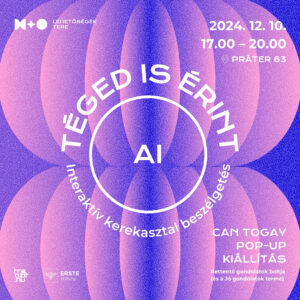
It Concerns You Too: Artificial Intelligence

17:00 - 20:00
2024 Dec. 13.

Household Practices - Clean without chemicals!

16:00 - 19:00
2024 Dec. 2.

Voice Circle

17:00 - 19:30
2024 Dec. 9.

Voice Circle

17:00 - 19:30
2024 Dec. 19.

Fembook - A visual glossary for a post-patriarchal society

Workshop host: Zsófi Puszt Contributor: Dóra Hegyi
18:00 - 20:00
2024 Dec. 5.

Fembook - A visual glossary for a post-patriarchal society

Workshop host: Zsófi Puszt Contributor: Dóra Hegyi
18:00 - 20:00
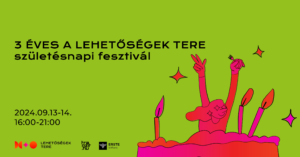
2024 Sep. 13. - 14.

Anniversary festival

2023 Oct. 20.

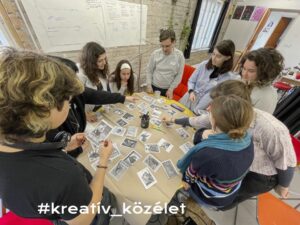
Creative Public Life. How to Create Change in Times of Democratic Crisis

Concept | Dóra Hegyi, Zsófia Puszt
2024 Jul. 3. - 6.

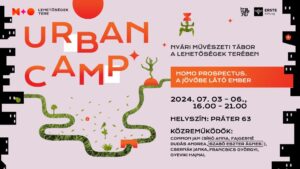
URBAN CAMP III

Concept | Judit Árva

WorldWide Club – Convo Night

18:00 - 20:00
Event
location | Práter 63
A facilitated speed-mingling for internationals and English speaking people

Looking for an effortless approach to making real connections? This is the right space of opportunity for you.


🌍 WorldWide Club Launches March 11 at Lehetőségek Tere 🌍


WorldWide Club is the first time at Lehetőségek Tere for international students and any other English speaking people to make connections and share perspectives in a speed-mingling, where participants change thematic discussion tables and groups in a casual environment. It’s a space to connect, share perspectives, and build a truly international community.​


Date: 11 March, 2026, 18.00-20.00
Venue: Lehetőségek Tere (1083 Budapest, Práter str. 63.)


At WorldWide Club, you can:

✨ Be vulnerable without judgment

✨ Grow personally through meaningful conversations

✨ Connect with people from diverse backgrounds

✨ Widen your perspective

✨ Share opportunities with peers


CONVO NIGHT

During the one-hour discussion session, you’ll rotate in small groups (3–5 people), exploring topics ranging from lighthearted icebreakers to deeper, thought-provoking conversations.


How it works:

👉 Choose from a list of topics you’d like to explore

👉 15-minute discussion rounds, then rotate groups

👉 Meet new people and exchange perspectives throughout the evening

👉 Snacks and open mingling at the end


💡 Topics may include quizzes, icebreakers, philosophical questions, controversial debates, and psychological games.


Apply here: https://docs.google.com/forms/d/e/1FAIp


🗓️ If this session goes well, we’ll make it a monthly event.


🎯 You might walk away with new contacts in your phone — but sharing details is completely optional. No pressure, always your choice.

Come as you are. Leave with new perspectives! 👁️

Survival Strategies III: Exercises in Pirate Care

10:00 - 19:30
Event
workshop
location | Práter 63
3 Seminars between February and April
Exercises in “Pirate Care”

The Space of Opportunity organizes the winter edition of its artistic seminar series for the third time, with the thematic frame of “pirate care”.

One of the deficiencies of contemporary societies is the abandonment of care. While mutual dependence and solidarity are key to the coexistence of humans, states embracing global neo-liberal economics place the responsibility of care on the individual or the immediate family, which may or may not function. Increasingly, the welfare state fails to properly perform its duties in health, education, culture and social care. The gap is partly filled by for-profit organizations, and occasionally NGOs, which leaves many without access to adequate care and services.

“Pirate care” denotes independent, grass-roots, solution-driven projects by NGOs or activists who dare to infringe the law if need be. The term was first applied in a broader sense by a transdisciplinary and transnational research project and network, formed in 2019 for the creation of a common, independent care infrastructure. The project includes initiatives that seek to counter general abortion bans, segregated education or the criminalization of homelessness. States often do not recognize such care practices, or even criminalize and persecute them.

For our part, we consider critical culture as yet another expression of care, which is capable of articulating contemporary problems and questioning the status quo with the aim of restoring and strengthening the capacity for change and action. At the same time, the neo-liberal world order, which disclaims social sensitivity, is another phase of capitalism in which the role of critical culture, and within it, of progressive art, is called into question. They are snubbed while the culture that receives support favours mass entertainment and such institutions that refrain from experimentation.

With this year’s Survival Strategies seminars, we invite you to join us in our attempt at pirate care in culture through the sharing of ideas and the experience of community—inclusive and accepting events that can inspire solidarity in other fields as well. We will be given a helping hand by artists who will propose subjects for the workshops and will host the joint exercises.

  1. ZSÓFIA GYENES- FERENC GRÓF

March 15, 2025.

10.00-17.00 workshop based on former application

https://forms.gle/ztYYGnPzsWX3VWpc9 (apply here until 10th of March)

18.00-19.30 public presentation


Meanders of ice

❄️The starting point for the workshop led by Zsófia Gyenes, a color and textile designer, and Ferenc Gróf, a visual artist, is Maria Mies’s iceberg metaphor. The German sociologist co-authored the book The Subsistence Perspective: Beyond the Globalised Economy (1999) with Veronika Bennholdt-Thomsen. One of its most famous diagrams depicts the iceberg model of the capitalist-patriarchal economy. The smaller, visible part of the iceberg represents capital and legally regulated labor governed by contracts, as well as the world of gross national income. The larger, “underwater” and invisible part comprises all those economic processes that fall prey to unregulated and ruthless exploitation.

♟During the workshop, we will reinterpret this diagram, which illustrates the economic oppression of the invisible majority, using one of the favorite graphic tools of administration: stamps. The workshop provides an opportunity to collectively explore Maria Mies’s ecofeminist critique and its emancipatory potentials. With the help of stamps and printing blocks, participants will create textile- and paper-based graphic works that reflect on the questions raised by the iceberg metaphor.

🧵Zsófia Gyenes (born 1977, Budapest) is a textile designer and visual artist. She studied in Budapest and Paris, graduating in 2004 from the textile department of ENSAD (École Nationale Supérieure des Arts Décoratifs). After nearly twenty years of working as a textile designer in the fields of fashion, interior design, and the automotive industry, she launched her independent artistic practice in 2022.

📈Ferenc Gróf (born 1972, Pécs) was a founding member of the Société Réaliste collective, where he developed a distinctive artistic language using linguistic and typographic elements, statistics, and cartographic symbols to examine social processes and reveal connections between the past and present. Following the dissolution of the collective, Gróf retained its analytical approach. His works focus on ideological imprints situated at the intersection of graphic design and spatiality.

Survival Strategies III: Exercises in "Pirate Care"

Event
workshop
location | Práter 63
3 Seminars between February and April

Exercises in “Pirate Care”
The Space of Opportunity organizes the winter edition of its artistic seminar series for the third time, with the thematic frame of “pirate care”.

One of the deficiencies of contemporary societies is the abandonment of care. While mutual dependence and solidarity are key to the coexistence of humans, states embracing global neo-liberal economics place the responsibility of care on the individual or the immediate family, which may or may not function. Increasingly, the welfare state fails to properly perform its duties in health, education, culture and social care. The gap is partly filled by for-profit organizations, and occasionally NGOs, which leaves many without access to adequate care and services.


“Pirate care” denotes independent, grass-roots, solution-driven projects by NGOs or activists who dare to infringe the law if need be. The term was first applied in a broader sense by a transdisciplinary and transnational research project and network, formed in 2019 for the creation of a common, independent care infrastructure. (1) The project includes initiatives that seek to counter general abortion bans, segregated education or the criminalization of homelessness. States often do not recognize such care practices, or even criminalize and persecute them.


For our part, we consider critical culture as yet another expression of care, which is capable of articulating contemporary problems and questioning the status quo with the aim of restoring and strengthening the capacity for change and action. At the same time, the neo-liberal world order, which disclaims social sensitivity, is another phase of capitalism in which the role of critical culture, and within it, of progressive art, is called into question. They are snubbed while the culture that receives support favours mass entertainment and such institutions that refrain from experimentation.


With this year’s Survival Strategies seminars, we invite you to join us in our attempt at pirate care in culture through the sharing of ideas and the experience of community—inclusive and accepting events that can inspire solidarity in other fields as well. We will be given a helping hand by artists who will propose subjects for the workshops and will host the joint exercises.


(1) https://pirate.care/pages/concept/


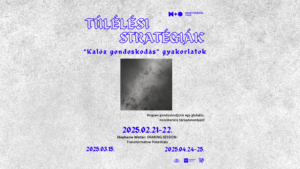
  1. STEPHANIE WINTER (Vienna)


February 21, 2025. 18.00-19.30
Public presentation by Stephanie Winter on the activity of Salon Hybrid and her aristic practice

February 22, 2025. 10.00-18.00 You must apply here to join


Stephanie Winter
SHARING SESSION: Transformative Potentials

This session offers an open and evolving space to explore the themes of transformative potentials through collective dreaming, creative exploration, and communal connection. Designed as a safer, inclusive environment, the workshop invites participants to reflect on societal challenges, care, activism, and togetherness while imagining new ways of being in the world.


The session is inspired by Ursula K. Le Guin’s The Carrier Bag Theory of Fiction which emphasizes the power of storytelling, care, and collaboration in shaping our future. Le Guin’s idea that we collect not only food, but seeds, stories, and perspectives will guide us as we come together to share and imagine. Through this process, we create space for transformative potentials to emerge, allowing for the building of solidarity and resilience in challenging times.


Throughout the day, participants will be invited to engage in different practices that activate both individual and collective potentials. The session will include meditative exercises, sharing session woven into a communal ritual and a constellation mapping.
Meditative exercises will be led by Stephanie Winter, which will help to reflect on our inner landscapes and open pathways for imagination and creativity. In the sharing session participants can contribute something personal related to care, hope, or transformation—a gesture, a song, an object, a thought, or a story. These offerings will be woven into a communal ritual, where acts of giving and receiving deepen our connection with one another and the world around us. Followed by a constellation mapping, which is a practice designed to visualize the links between inner and outer landscapes. This activity will help us reflect on how personal care and communal solidarity intersect, offering new perspectives on how we relate to ourselves, each other, and the world we inhabit.


What to Bring:
Participants are invited to bring a personal offering related to the theme of care, hope, or transformation—this could be an object, a song, a story, a gesture, or a thought.


Who Should Attend:
This workshop is open to anyone curious about exploring themes of care, transformation, community, and creative expression. Whether you’re an artist, activist, or simply interested in collective healing and imaginative thinking, this session offers an opportunity to engage in meaningful dialogue and connection. No prior experience is needed—just bring your curiosity and an openness to share.


STEPHANIE WINTER’s works have been showcased at international film festivals and exhibitions, earning multiple awards. She operates at the intersection of artistic research, performance, music, immersive installation, and film through her performative office, SALON HYBRID, and the MOTHERBOARD Artspace, which she opened in 2021. With a strong affinity for feminist, science and eco-fiction, Stephanie Winter and SALON HYBRID create fictional „bubbles“ and scenarios that blend research, social study, artistic, and psychological processes into diverse experiments. Winter‘s practice involves integrating experts, artists, visitors, and other living beings into her laboratories, installations, narratives, and alternative worlds.

Philosophy Circle

18:00 - 21:00
Event
location | Práter 63

The Philosophy Circle is amonthly club open to everyone interested. It explores philosophical self-formation and community-building through discussions, focusing on how movies reflect universal contradictions and dilemmas and transforming these into philosophical problems.

Facebook event

Philosophy Circle

18:00 - 21:00
Event
location | Práter 63

The Philosophy Circle is amonthly club open to everyone interested. It explores philosophical self-formation and community-building through discussions, focusing on how movies reflect universal contradictions and dilemmas and transforming these into philosophical problems.

Facebook event


Philosophy Workshop

18:00 - 21:00
Event
workshop
location | Práter 63

The Philosophy Workshop’s closed, fortnightly sessions focus on self-formation and community-building through philosophical practices, examining virtues such as simplicity, generosity, and humility. Participants engage in practical exercises based on André Comte-Sponville’s Little Book of Great Virtues, exploring topics like humor, generosity, humility, and different forms of love.

Philosophy Workshop

18:00 - 21:00
Event
workshop
location | Práter 63

The Philosophy Workshop’s closed, fortnightly sessions focus on self-formation and community-building through philosophical practices, examining virtues such as simplicity, generosity, and humility. Participants engage in practical exercises based on André Comte-Sponville’s Little Book of Great Virtues, exploring topics like humor, generosity, humility, and different forms of love.

It Concerns You Too: Artificial Intelligence

17:00 - 20:00
Event
location | Práter 63

The interactive roundtable discussion-series continued with the topic of artificial intelligence and its effects, with experts representing the areas of art, philosophy, psychology and technology. The event was open to the public, with a moderated conversation followed by a Q&A session. As usual, this episode was recorded as a podcast and will be uploaded to our Spotify channel.

Facebook event

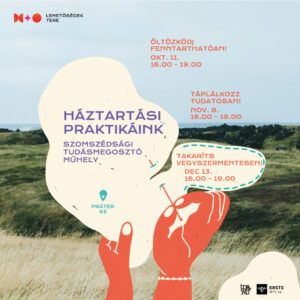
Household Practices - Clean without chemicals!

16:00 - 19:00
Event
workshop
location | Práter 63
The Household Practices’ next workshop is about creating eco-friendly cleaning products, focusing on the essentials of chemical-free cleaning using cheap and environmentally friendly alternatives.

Voice Circle

17:00 - 19:30
Event
workshop
location | Práter 63

The Voice Circle is a creative workshop-series focusing on self-discovery, experimentation, expression, and connection, where participants bring their own stories to life through singing and movement. The sessions, held every Monday at 5 PM, are free and open to everyone.

Voice Circle

17:00 - 19:30
Event
location | Práter 63

The Voice Circle is a creative workshop-series focusing on self-discovery, experimentation, expression, and connection, where participants bring their own stories to life through singing and movement. The sessions, held every Monday at 5 PM, are free and open to everyone.

Fembook - A visual glossary for a post-patriarchal society

18:00 - 20:00
Event
workshop
location | Práter 63
Workshop host: Zsófi Puszt Contributor: Dóra Hegyi

Collective photobook workshop

📕The second Photobook Workshop will focus on the production of a collective book that explores the subject of patriarchy.

✌️As an active women’s collective in Hungary, we would like to take part in the struggle against patriarchy with this project, and we invite the participants of the photobook workshop to join this effort. We have chosen this subject because, in our experience, patriarchy as a system of power hinders us from being solidary and supportive in relation to society and nature. 

This is not a new objective, but something that all generations of feminist movements have fought for; the questioning of the male-centred worldview has left behind the framework wherein the focus was mainly on subordination and fairness in male-female relationships, and is carried out with a consideration of the disadvantages that derive from social class and minority status as well .

👀 We set as the goal of the workshop series to create a joint Fembook, a collection of images and concepts, based on our own photographs. The Fembook departs from concepts with positive or negative connotations that we may know but do not consider in sufficient depth in our daily lives. Yet getting to know these terms and critically analysing them is necessary to  be able to speak a common language and to counter the injustice of patriarchy.

The starting concepts are care, silence (or being silenced), patriarchy, masculinity vs. femininity, queer, sensitivity, love, equality, work, dominance, harmony, solidarity, independence, diversity and community. As we work, participants may suggest new concepts to be added to or removed from this list.

💬During the ten workshops, we will discuss short texts to familiarise ourselves with the concepts and then recreate them visually. Finally from the compiled photographs we will create the artist’s book together.

📢 We consider it important that not only women feel encouraged to participate because men can also be negatively impacted by patriarchy as a power structure, and because we are convinced that it is only by joining forces we can aim a new world view that displaces patriarchal society.

Details:

📷 As soon as photography became a more widely accessible  genre from the middle of the 19th century on, there were women who practised the art and made photobooks—while remaining invisible for the public eye, as so often in other fields of culture and society. The first photo-based book is credited to Henry Fox Talbot, whose 1844 The Pencil of Nature is an important chapter in the history of photobooks. Even though Anna Atkins had published her The British Algae: Cyanotype Impressions a year earlier,  photographic history remembers Talbot as the first pioneer of photography-based books— a glaring example of patriarchy (in this case: more support and visibility for male artists) shaping our view of art and society.

📕 Later, participatory fanzines emerged in opposition to canonised culture and mainstream media. Collective publishing not only facilitates acquiring knowledge from different fields, but also makes it possible to experience and shape contemporary art and culture. This is our motivation for the creation of a collective “Fembook” at this workshop. [1]

👥 The first sessions of the workshop focus on the theoretical aspects of the subject, though every time we will also look at the practicalities of creating images and compiling a photobook. Each participant will choose a concept, find a partner to work with, and the pairs will explore their subject through the means of photography.

At one of the sessions, we will be joined by visual artists who use photography or photobooks in their investigations of feminine subjects. The aim of discussion with them is to inspire and motivate the participants in realising their projects.

In the final stage, we will make use of the completed photo projects to create the book together. The workshop will conclude with an exhibition and book launch in the Space of Opportunity.


👤 Workshop host: Zsófi Puszt

👥 Contributor: Dóra Hegyi

[1] “Fembook” is from the term “Femzine”, which is a common name for queer and feminist zines in the United States.

Fembook - A visual glossary for a post-patriarchal society

18:00 - 20:00
Event
workshop
location | Práter 63
Workshop host: Zsófi Puszt Contributor: Dóra Hegyi

Collective photobook workshop

📕The second Photobook Workshop will focus on the production of a collective book that explores the subject of patriarchy.

✌️As an active women’s collective in Hungary, we would like to take part in the struggle against patriarchy with this project, and we invite the participants of the photobook workshop to join this effort. We have chosen this subject because, in our experience, patriarchy as a system of power hinders us from being solidary and supportive in relation to society and nature. 

This is not a new objective, but something that all generations of feminist movements have fought for; the questioning of the male-centred worldview has left behind the framework wherein the focus was mainly on subordination and fairness in male-female relationships, and is carried out with a consideration of the disadvantages that derive from social class and minority status as well .

👀 We set as the goal of the workshop series to create a joint Fembook, a collection of images and concepts, based on our own photographs. The Fembook departs from concepts with positive or negative connotations that we may know but do not consider in sufficient depth in our daily lives. Yet getting to know these terms and critically analysing them is necessary to  be able to speak a common language and to counter the injustice of patriarchy.

The starting concepts are care, silence (or being silenced), patriarchy, masculinity vs. femininity, queer, sensitivity, love, equality, work, dominance, harmony, solidarity, independence, diversity and community. As we work, participants may suggest new concepts to be added to or removed from this list.

💬During the ten workshops, we will discuss short texts to familiarise ourselves with the concepts and then recreate them visually. Finally from the compiled photographs we will create the artist’s book together.

📢 We consider it important that not only women feel encouraged to participate because men can also be negatively impacted by patriarchy as a power structure, and because we are convinced that it is only by joining forces we can aim a new world view that displaces patriarchal society.

Details:

📷 As soon as photography became a more widely accessible  genre from the middle of the 19th century on, there were women who practised the art and made photobooks—while remaining invisible for the public eye, as so often in other fields of culture and society. The first photo-based book is credited to Henry Fox Talbot, whose 1844 The Pencil of Nature is an important chapter in the history of photobooks. Even though Anna Atkins had published her The British Algae: Cyanotype Impressions a year earlier,  photographic history remembers Talbot as the first pioneer of photography-based books— a glaring example of patriarchy (in this case: more support and visibility for male artists) shaping our view of art and society.

📕 Later, participatory fanzines emerged in opposition to canonised culture and mainstream media. Collective publishing not only facilitates acquiring knowledge from different fields, but also makes it possible to experience and shape contemporary art and culture. This is our motivation for the creation of a collective “Fembook” at this workshop. [1]

👥 The first sessions of the workshop focus on the theoretical aspects of the subject, though every time we will also look at the practicalities of creating images and compiling a photobook. Each participant will choose a concept, find a partner to work with, and the pairs will explore their subject through the means of photography.

At one of the sessions, we will be joined by visual artists who use photography or photobooks in their investigations of feminine subjects. The aim of discussion with them is to inspire and motivate the participants in realising their projects.

In the final stage, we will make use of the completed photo projects to create the book together. The workshop will conclude with an exhibition and book launch in the Space of Opportunity.


👤 Workshop host: Zsófi Puszt

👥 Contributor: Dóra Hegyi

[1] “Fembook” is from the term “Femzine”, which is a common name for queer and feminist zines in the United States.

Anniversary festival

THE SPACE OF OPPORTUNITY IS ACTVE FOR THREE YEARS!🎂🎂🎂
ANNIVERSARY FESTIVAL AT PRÁTER 63
On September 13-14, 2024 between 4 and 9 pm, you can gain insight into the activity of the Space of Opportunity!
During the two days you can join programs led by the team of the Space of Opportunity. Despite participating at workshops visitors are welcome to come during both afternoons.
❗Please register to some of the programs, which are limited in participants.  https://forms.gle/zAspDEFFGWmqfdmh6 ❗
Come, meet is again and if you’ve never been here before, now’s your chance to get to discover the space!
DAY 1 (Friday, 13/09)
16.00-21.00
#EXHIBITION 🖼 – A selection of works from the workshops of the community space
#FOOD_DRINK 🥪– There will be delicious treats during both afternoons
#KID_SECTION 🎨 – Potato stamp opportunity for kids and adults
16.15-16.45
#TOUR 👥 – Guided tour in the Space of Opportunity
16.00-19.00
#PHILOSOPHICAL_PRACTICE_CIRCLE 💭 – Practising philosophical thinking in everyday life
Strangers can engage in conversation around a philosophical menu of questions.
16.30-18.30
#PHOTOBOOK_AND_ZINE_WORKSHOP 📸
Under the guidance of photographer Zsófia Puszt, you can get an insight into the photobook and photozine genre and plan your own book design based on archival pictures or your own photos.
17.00-17.45
#PARK_WALK 🌳 – Walks in city parks
Urban planner Györgyi Francsics will invite visitors to discuss the story of Molnár Ferenc Square, which is next to our community space.
18.15-19.00
#VOICE_CIRCLE 🤸‍♀️ – Inner journey with sounds and movement
Ágnes Sarlós and members of the Voice Circle invite participants to a short sound and movement experiment.
19.00-20.00
#BIRTHDAY_CAKE 🎂 – Birthday cake and informal public talk with the team members of the space
Team members will line up their baking skills and moderator Ildi Nagy will ask founding and team members.
20.00-21.00
#JAMTRIP 🎶 – Electroacoustic concert
Nándi Hevesi, who led the impro music club Jam Trip in the space for two years, and his fellow musicians will play: Nándor Hevesi – bass guitar, Dx7, Árpi Kiss – trumpet, electronics, Kristóf Velsz – guitar.
______________________________________________________________________
DAY 2 (Saturday, 14/09)
16.00-21.00
#EXHIBITION 🖼 – A selection of works from the workshops of the community space
#FOOD_DRINK 🥪– There will be delicious treats during both afternoons
#KID_SECTION 🎨 – Potato stamp opportunity for kids and adults
16.15-16.45
#TOUR 👥 – Guided tour in the Space of Opportunity
16.30-18.00
#GREEN_BOOKCLUB 📖 – Discussion on environmental issues
Dóri Szabó and Anna Horváth will initiate a discussion and a craft workshop on indigenous knowledge based on the book Braiding Sweetgrass written by Robin Wall Kimmerer.
16.00-18.00
#SURVIVAL_STRATEGIES 🌾 – Art workshops to model what we can do for the world
At the festival artists Kitti Gosztola and György Bence Pálinkás invite for a *Wild Garden Utopia* workshop where the participants interact with their senses with an alien invasive species, the Japanese knotweed. “We taste, smell, touch, listen and exercise radical empathy towards the plant that is so alien to us that we even deny its suffering. During the workshop we will put ourselves in the plant’s position through an imagination exercise. We talk about hatred against alien species and the rights of plants. We will taste Japanese knotweed and make music on simple instruments made from the plant.”
18.00-19.30
#IT_CONCERNS_YOU_TOO 🗣 – Roundtable discussions on overheard and overdiscussed topics
This time we will discuss the impact of art with artists and curators. The panellists are Tamás Don, Andrea Fajgerné Dudás, Kitti Gosztola, Zsuzsi Simon Moderated by Dóra Hegyi.
20.00-20.30
#CONCERT 🎸 – Concert by Ágnes Sarlós (Dajna) and Kende Sarlós
Ági Sarlós is a self-taught guitarist, who performs her own songs accompanied by her musician son.

Creative Public Life. How to Create Change in Times of Democratic Crisis

10:00 - 20:30
Event
workshop
location | 63 Práter Street
Concept | Dóra Hegyi, Zsófia Puszt

Educating young people about human rights, democratic action and solidarity plays a crucial role in enabling them to form opinions about the events happening around them and to stand up against the growing extreme right-wing and authoritarian ideologies, as well as the political movements that emerge from these.

The use of artistic methods can play a crucial role in cultivating a culture of debate and critical thinking. In recent years, the importance of informal forms of learning, including participatory art strategies and activist art, has gained ground as a means to encourage political participation and action within communities. The transdisciplinary nature of art and its practice of thinking outside of the box, supporting experiential learning and critical thinking is providing young people with opportunities to not only explore their creativity but also to feel included and engaged.

We consider the format of our gathering a workshop-conference because its primary goal is to share knowledge through practical experience. The original meaning of the term ‘conference’ is a meeting of two or more persons to discuss matters of common concern, and this is what we wish to emphasise. The workshop-conference aims to connect NGOs, artists, critical educators, and young people to gain multiple perspectives, think together and find solutions to challenges in activism and civil participation within an interdisciplinary laboratory. During the two days, all participants will engage in workshops led by artists and political scientists, and equally contribute to the discussions guided by the questions posed by the youngest generation.

📅 Thursday 19 October

18.00- 20.00
Exhibition Opening:
Keeping Freedom in Mind. Civil Resistance 2010-2023

The exhibition highlights major civil movements organised in response to the anti-democratic measures of the NER (acronym of Nemzeti Együttműködés Rendszere / System of National Cooperation in English), which was announced in 2010 by the FIDESZ and Christian Democratic People’s Party fraction. NER is a seemingly democratic social contract, but in fact an over regulated and anti-democratic system, close to the structure of dictatorial government. This leadership of the country is , currently in its third term of governance, has held power for nearly a decade and a half. This research-based documentary exhibition, accompanied by the works of contemporary artists, covers civil ‘answers’ of this period for the suppression and unjustice, emphasising the importance of art both as a field and as a means of resistance.

📅 Friday 20 October

Informal-Radical Education
The first day will focus on education, art and activism, exploring questions such as: How can critical pedagogy and art activism support active citizenship education? How can learning communities outside the public education system challenge the status quo and why is it necessary? What are the experiences in education that hinder active participation in society? And what kind of civic education do young people envision?

10.00-10.15
Welcome and Program Introduction

10.15-15.00, including lunch break between 12.30-13.30
Workshop and action with Marina Naprushkina and Nadira Husain, artists based in Berlin.

The workshop by Nadira Husain and Marina Naprushkina will centre around the concept of art education, equal access to educational institutions, using *foundationClass, an educational initiative for immigrant students within Weißensee Kunsthochschule, as an example, and the creation of self-organised platforms, like Neue Nachbarschaft/Moabit and Moabit Mountain College. Both artists have activist practice and are lecturers of the *foundationClass, beside that Naprushkina is a founder of Nachbarschaft as well. By asking ourselves questions such as: What constitutes a place of learning? And if places of learning are not limited to schools and universities, how can knowledge be acquired, and how do self-organised spaces like alternative schools emerge and function? Participants will delve into concepts and strategies around the idea and practice of equal access to study, regardless of race, socio-economic status, gender, or age. We explore artistic practices as tools for communication, visibility, sharing history and addressing concerns, particularly within marginalised communities. You will be invited to join the discussion and contribute to shape the educational landscape.

15.00-15.30 Coffee Break

15.30-17.30 World Cafe
Discussion circles in World Cafe format, hosted by young people. Participants rotate between three groups
This session aims to bring together different informal educational formats that have emerged as responses to the need for change, often transforming or transcending existing institutional boundaries. Activists, artists, and researchers working with these unveil and explain social and political problems before they become widely recognised. How can their insights be effectively communicated to a broader audience and take a form of action?

Thematic Sessions

1. Free art schools

▪ *foundationClass, Berlin is a study programme at Weißensee Kunsthochschule Berlin, consisting of lectures, workshops and excursions led by professional artists, designers, academics and activists with migration backgrounds.
▪ Freeszfe Society is an independent theatre and film school founded in 2020, aiming to continue the traditions of the former University of Theatre and Film in Budapest following a political change in school leadership.
▪ SZEMinárium is a free and critical educational initiative of a college for advanced studies at the Babes-Bolyai University in Cluj, linked to the critical portal Új Szem (https://ujszem.org/).
▪ Youth Center CK 13, Novi Sad is an independent social and cultural centre dedicated to strengthening the self-organising and social engagement of citizens, with a particular focus on youth.

2. Neighbourhood

▪ Pneuma Szöv. is an art co-operative, active mainly in Budapest since 2008, with collaborations and temporary initiatives in Germany and beyond. The collective has been building an open network in the 8th district of Budapest.
▪ Orczy-Neighbours Project initiated by neighbourhood-based Gólya Cooperative and is a participatory research and art project focusing on the history and the communities living in the Orczy neighbourhood of Budapest’s 8th district, with the aim to change the stereotypical view connected to it.
▪ Uccu Roma Informal Educational Foundation, Budapest is an informal education initiative providing a platform for dialogue between Roma and non-Roma communities to combat prejudices and negative stereotypes related to Roma.
▪ Neue Nachbarschaft Moabit is a self-organised migrant-based community founded in 2013 in Berlin. Professional artists of different disciplines collaborate with self-taught artists and individuals with no artistic background, focusing on knowledge exchange and mutual support.

3. Informal Learning in a Nonformal Setting

▪ Rena Rädle & Vladan Jeremić are visual artists based in Belgrade and Berlin. In their collaborative practice the artists explore the relation between art and politics, unveiling the contradictions of today’s societies and developing transformative potentials of art in the context of social struggles.
▪ Romaversitas, Budapest is the first comprehensive support and training program for talented Roma youths in Hungary, founded in 1996. The organisation helped 300 students to successfully complete their academic studies.
▪ Deviszont Community Space, Budapest is an initiative that provides young people in vocational education and training with an alternative learning and leisure opportunity.Their project-based activities are in critical pedagogy and experiential education and support young people to become informed adults and active citizens.
▪ Polémia Institute, Budapest is a community of young social scientists dedicated to making politics more understandable for people not specialised in the field.
▪ Space of Opportunity, Budapest is a cultural-educational programme and a community space for young adults (16-35 years old). It provides an opportunity to engage in critical thinking and in dialogue in encounters, experiential learning and creation.

18.00-19.00 Dinner

19.00-20.30 Game on politics developed by Polémia Institute
The Democracy Assassin – an interactive workshop game
In the country of the Piréz, the form of government is a democratic republic. However, every system has its opponents. The demagogues secretly wish for a dictatorship instead of democracy. They are tired of debating and want to take action instead. The democrats, on the other hand, are the guardians of democracy and believe in the power and importance of communal decision-making and discussion. During the game, the demagogues’ goal is to eliminate all democrats so that no one stands in their way when seizing power, but this is not an easy task. The demagogues strike at night, but the democrats are not idle either. Will the democrats manage to survive the scheming of the demagogues and stay alive? Let’s play and find out!

📅 Saturday 21 October

Learning Activism in Communities
The second day will focus on active citizenship, how taking initiative can grow from the bottom up through self-organisation, and how solidarity and knowledge can be spread among activist communities. Key questions of the day include: How can members of society be motivated to engage in political participation? How can artistic strategies contribute to this motivation? How can we identify pressing issues and generate interest in participating in efforts for change?

10.00-12.30
Parallel workshops:

1. Workshop and action with Rena Rädle & Vladan Jeremić
The three-hour workshop aims to bridge the gap between art and activism, offering valuable insights for practitioners in both fields. The first segment will provide an overview of transformative artistic practices, drawing on examples from the artists’ own experiences of how art can be useful in social struggles, and community-building solidarity activities. The main part of the workshop will focus on the creation of a collective drawing with acrylic paint on textile. Participants will visualise a burning issue and the local activism related to it, which they will propose, choose and execute themselves. To do so, participants will first depict the current situation and then make interventions by adding drawings (or text) to illustrate how they envision changing this situation. They can choose a metaphorical or even fictional approach, or propose practical steps; every approach is welcome. This way, participants will create a meaningful and impactful textile banner with a collective design, drawing and text.
Meeting Point: Space of Opportunity at Práter 63.

2. Workshop with Pneuma Szöv.
The workshop offers insights into the tools and practices of the art network Pneuma Szöv. In the first half, participants will explore the work of the art collective including their involvement in Budapest’s 8th district, their approach to creating public spheres through a fusion of arts, activism and poetry. After a walk through the district to the Space of Opportunity, the second half of the workshop will introduce some reflective tools used in the Pneuma Szöv. project “The Spectacular Society”, developed in the spring of 2022 through a series of workshops and soirées.
Meeting point: 26 Népszínház street (near Blaha Lujza square)

12.30-13.30 Lunch

13.30-15.00 Second part of the workshops at and around The Space of Opportunity

15.30-17.30
Discussion circles in World Cafe format, hosted by young people. Participants rotate between two groups
This session aims to connect local and international organisations to discuss common or distinct challenges on equal footing. Panellists will explore various methods of effecting change, including community organising, solidarity-driven movements, campaign organisations for public causes, political movement organisations, and transnational connections of social and political movements.

Thematic sessions

1. Organise yourself

▪ School of Transnational Organizing is a grassroots school initiated and run by European Alternatives’ Berlin Hub. It brings together different groups of the society to learn the tools and skills needed to master the lost art of organising solidarity.
▪ Civil College Foundation Hungary is an adult education organisation focused on community development, community work and citizen studies, actively engaged in community organisation.
▪ ADOM Student Movement is a Hungary-wide, self-organised and student-led organisation in solidarity with the social position of teachers, founded in 2014. It aims to create a modern, student-centred and equality based education system in Hungary.

2. Leftist traditions

▪ School of Transnational Organizing is a grassroots school initiated and run by European Alternatives’ Berlin Hub. It brings together different groups of the society to learn the tools and skills needed to master the lost art of organising solidarity.
▪ Egységes Diákfront (EDF) is a Hungary-wide active student organisation founded in 2022 as a reaction to demonstrations, engaged in solidarity efforts with teachers in Hungary. The student members of the organisation recently initiated a referendum about the educational system and fair salary for teachers.
▪ Szikra (“Spark”) is a Hungarian green-left political movement. Focusing primarily on housing, labour, and environmental issues, it engages in community building, direct action, educational activities and institutional politics.
▪ „A Város Mindenkié” / „City is for All” was founded in 2009 by people who are committed to working for a just and egalitarian society and taking action on housing issues. Their members are currently or formerly homeless people, those experiencing housing poverty and their allies.

18.00-19.00 Dinner

19.00 Karaoke based on shared learnings, facilitated by Pneuma Szöv.

Concept: Dóra Hegyi, Zsófia Puszt

Realisation: Judit Árva, Györgyi Francsics, Dóra Hegyi, Zsófia Puszt, Dóra Szabó

URBAN CAMP III

Event
workshop
location | 63 Práter Street
Concept | Judit Árva

Homo prospectus. Seeing into the Future [1]

But let’s not speak of facts. Facts matter to no one anymore. They are mere points of departure for invention and reasoning.
Jorge Luis Borges: ‘Utopia of a Tired Man’ (1975) [2]

The Space of Opportunity presents its third Urban Camp, a series of art workshops in the summer. The first series concentrated on the here and now, on the empirical experience of the urban environment through our senses, while in the second edition we invited the participants to descend into the deep layers of history. It seems logical that after the present and the past, our focus should be on the future: we will continue to use the urban environment as our ‘playground,’ as participants can discover or create unbeaten paths.

Unknown and elusive, the future has been a preoccupation of humanity since the beginning of time: notions of it are both deeply rooted in the various layers of society, and determine the development of the latter. Prophecies and visions have started or ended wars, contributed to the creation of cities, and certain notions of the future influenced the appearance of the built environment. What we see in the future is usually some extreme outcome, with relatively few shades between a paradisiacal state and the complete enslavement or extinction of humanity.

An (overly) positive vision of an ideal future we desire or wish to attain is called a utopia. Coined by Sir Thomas Moore from the Greek ou (‘not’) and topos (‘place’), the word literally means ‘no place’ or ‘nowhere-land.’ It denotes a vision of the future that cannot be realized, a fantasy divorced from rational and objective reality, never to be reached. As a literary genre, utopia often describes a possible future in the form of a travelogue; the first book of this kind was Moore’s Latin Utopia of 1516, whose complete title—somewhat long-winded, though in keeping with the fashion of its time—in fact translates as A truly golden little book, not less beneficial than enjoyable, about how things should be in a state and about the new island Utopia. [3] The form of the travelogue allows the reader to discover the vision of the future in question as if it were a real continent or city.

The other pole consists of dystopias, also called anti-utopias or cacotopias: though they often reflect on the problems of the present, they are pessimistic visions of a future that holds a negative outcome for humanity. They describe societies dominated by the worst qualities of humanity or a reality rendered unrecognizable by the human ‘factor,’ a global catastrophe, or mankind’s complete destruction: these are bleak, often terrifying visions.

Thinking about the future is not just a privilege or a literary fantasy, it is also a driving force of humanity and a key to its survival. It is a characteristic that is at work in us all the time, consciously or unconsciously, both in the short and long term. [4] If it is impossible not to look into the future, what are our options between the two poles? Since utopias are unattainable and dystopias, undesirable, what is the field that exists between these two spheres? How can we move within this framework, away from both apocalyptic visions and paradisiacal states, starting from the realities but using our imagination? In this year’s edition of the Urban Camp, we look for answers to questions like these and more.

Concept: Judit Árva

Contributors:
07.03. Common Jam (Andrea Fajgerné Dudás, Anna Bíró, Ágnes Szabó Eszter) visual artists
07.04. Francsics Györgyi urban planner
07.05. Hajnal Gyeviki ceramist, founder of the Soil Sciart Society
07.06. Janka Csernák social designer researcher

Realization: Györgyi Francsics, Dóra Hegyi, Dóra Szabó, Zsófia Puszt

[1] Martin E. P. Seligman et al., Homo Prospectus (New York: Oxford University Press, 2016). For an accessible summary, see Martin E. P. Seligman, John Tierney: ‘We Aren’t Built to Live in the Moment,’ New York Times, 19 May 2017, https://www.nytimes.com/2017/05/19/opinion/sunday/why-the-future-is-always-on-your-mind.html (last accessed 20 March 2024). Another source I used was this essay: Máté Makai, ‘A jövőbe látó ember,’ 1749, 24 May 2021, https://1749.hu/fuggo/essze/a-jovobe-lato-ember-es-a-disztopia-otthonossaga.html (last accessed 20 March 2024).
[2] In: Jorge Luis Borges, The Book of Sand, trans. Norman Thomas de Giovanni (New York: E. P. Dutton, 1977), 91.
[3] Zsolt Czigányik, ‘Utópia álom és rémálom között,’ Vigilia 87, no. 4 (2022): 288.
[4] See Martin E. P. Seligman and John Tierney’s article.