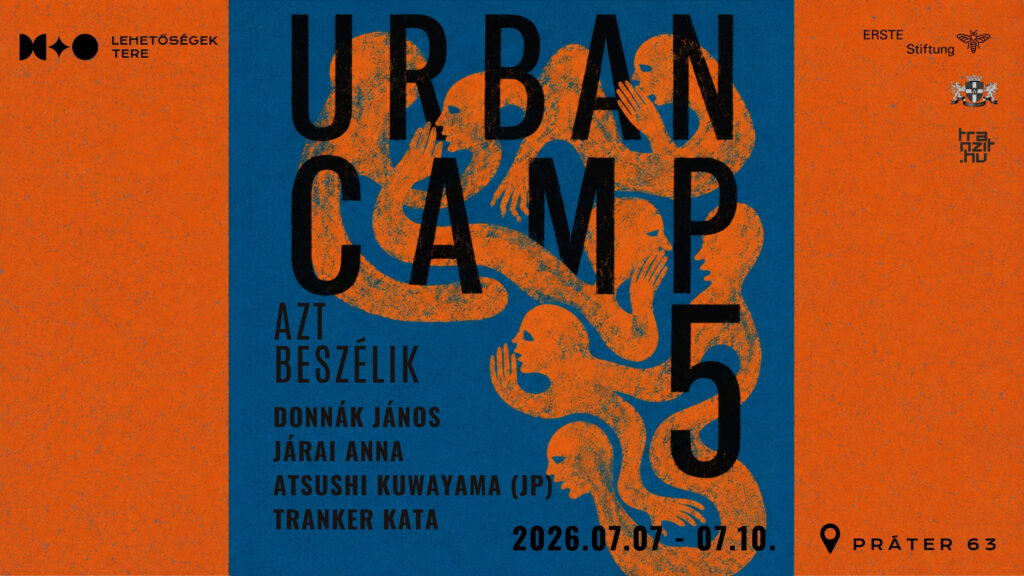
Jul. 7. - 10.
Urban Camp 5 – I Heard a Rumor
“I speak and speak,« Marco says, »but the listener retains only the words he is expecting. […] It is not the voice that commands the story: it is the ear.”
Italo Calvino, Invisible Cities*
📆 Dates: July 7–10, 2026, 4 pm – 9 pm each day
📍 Venue: Práter 63 (1083 Budapest, Práter u. 63.) and its surrounding
Urban Camp, the summer art camp of the Space of Opportunity, is back for its fifth edition. In the last four years, we approached urban spaces from various angles: perceived them through our senses, dug into their historical layers, imagined their possible futures, and explored their non-places — both in a physical and a metaphorical sense. This time, we will venture into the territory where history, myth, and misinformation blur.
Urban spaces, cities are full of stories and narratives. Some are documented, some are passed on, some are invented. Official histories coexist with rumors, urban legends circulate as facts, and the digital space gives an unlimited platform for fake news, which affects how people understand the places they live in. Our neighborhood, the wider ‘home’ of our community space — Józsefváros (the 8th District of Budapest) — is a territory rich in urban legends and myths. Even its name carries a layer of uncertainty. It is widely believed that the district was named after Joseph II. But according to a rumor, the name Józsefváros (Josefstadt) was originally proposed in the 1770s in honor of Saint Joseph, the foster father of Jesus and patron of the church in the Horváth Mihály square. Maria Theresa, assuming the name referred to her son, the future ruler of the Monarchy, happily accepted.[1]
Over the centuries, many stories have shaped the district’s image. They are so deeply embedded in its texture that it is almost impossible to distinguish facts from myths. The trope of ‘nyócker’ — the district’s reputation as a kind of sin city — has likewise been fueled by rumors, which have irreversibly shaped its identity.
What interests us is not simply whether something is true or false, but how these stories work: how they spread, how they mutate, transform, and how, at some point, they start to feel real. Myth-making can be both a tool of control and an act of resistance, and the line between the two is rarely clear. With the invited artists, we will engage not only with specific stories but with the nature of storytelling itself — playing with fictions and non-fictions to understand how and why we believe what we believe.
In an era of political and commercial propaganda, disinformation, and fake news, understanding the agency behind non-facts is more than an intellectual exercise — it is a compass for navigating everyday life.
If myths and legends are among the dominant materials of urban space, we want to work with them—not merely analyze them. Following anthropologist Tim Ingold, for whom knowledge emerges through making and direct engagement with materials [2], the camp treats stories as raw material for narrative construction. Throughout the camp, with the guidance of the artists, we are going to re-invent stories, construct and distort sounds, and stage performative interventions — building an unusual archive, unstable by design, that brings the mechanics of belief into light. If the city is a space of competing stories, then we have to become both its archaeologists and its mythmakers.
We have envisioned the fifth edition of Urban Camp as an expanded project. In cooperation with our neighbors, we would like to collect stories, urban legends, and myths attached to this part of the city — narratives tied to the venues, figures, and events of the Magdolna and Losonci Quarters of the 8th District. For this, we will install a ‘whispering box’ in our Parklet to collect stories directly from passersby, and we will also invite our neighbors to share urban legends via email at kozosseg@lehetosegektere.hu.
Participating artists: János Donnák (HU), Anna Járai (HU), Atsushi Kuwayama (JP), Kata Tranker (HU)
Concept by Judit Árva & Erekle Chinchilakashvili
 Camp Days:
07.07. (Day 1)
János DONNÁK: Wandering Voices
How do sounds emerge and wander to different places? How are they modulated and transmitted through our surrounding surfaces, and through what kind of interactions do they reach us like nomads?
Today, a sound is easily captured and made repeatable. Does this definitively seal these forms, or are they merely resting on their journeys? Sounds as building blocks, toolkits, and bonds. They submerge and resurface, while we pursue them with our custom-made stethoscopes to better understand their inner workings and private lives.
During the workshop, we experiment with the strange intertwining of sound and electronics in our temporary laboratory. We assemble and activate custom-made microphones and small recording devices, aiming not just to investigate, but to transmit what we find.
In the second half of the session, each participant builds a DIY, hacked audio player to test out sonic games and exercises, culminating in the creation of a collective performance-installation.
János Donnák is a visual artist. Key elements of his mixed-media objects are playfulness, DIY, and various sound experiments. He is currently pursuing doctoral studies at the Hungarian University of Fine Arts, alongside which he runs workshops on craft electronics and sound.
07.08. (Day 2)
Anna JÁRAI: Whispering Web. Mapping personal mythologies through performance-based animation
Inspired by Silvia Federici’s feminist essay on gossip, this workshop I invite participants to map and make visible the spiderweb of stories, secrets, and knowledge that connect us. The session serves as an attempt to reclaim “gossip” as a powerful, historic tool for community-building and shared myth-making.
The journey begins in the body. Through a guided movement exercise, participants will translate personal histories and neighborhood myths into coded gestures, creating short, symbolic choreographies that they will then capture on video.
Utilizing a technique from my own artistic practice, these digitized movements will then be printed and translated back into the physical, analog world.
In the final phase, participants will layer mixed-media animations directly onto their captured frames, adding a level of abstraction and motion. By blending performance, video, and animation, attendees will craft unique visual snippets: moving artifacts of their own personal mythologies.
Anna Járai is a filmmaker and artist based in Budapest. In her research, she explores the themes of embodiment and memory from a feminist critical perspective, creating performance-based, cross-disciplinary videos, photos and installation artworks. She is deeply inspired by folklore, family and local history, which she often references in ritualistic reinterpretations. She graduated from the Film program of Falmouth University in 2022, and is currently a graduating student of the Hungarian University of Fine Arts.
07.09. (Day 3)
Kata TRANKER: Fictional/True Local Stories
The Space of Opportunity is situated in a location with a particularly exciting and mysterious history. At first glance, the blocks of houses known as the Papházak (priests’ houses) and Molnár Ferenc Square seem to hold nothing remarkable, but if we travel back in time a hundred years or so, extraordinary stories begin to unfold before our mind’s eye.
During the workshop, an archival photograph will offer us a glimpse into the lives of people once connected to this neighborhood, and help us imagine ourselves within the cityscape of Józsefváros around the turn of the century.
Based on this photograph, we can each construct our own narratives and myths using paper-making techniques. We’ll repurpose various types of paper and, from multicolored paper pulp, create new sheets patterned according to our own ideas. We will also incorporate elements of the archival photograph into the paper — the very image that served as our point of departure at the beginning of the workshop. The works created by the participants will thus be interpretable both individually and collectively when placed side by side, giving rise to layered, multifaceted — and entirely fictional — stories.
In the workshop, we’ll work by hand with tangible materials to create a physical object, allowing us to experience the slow, meditative process of making. We’ll use simple tools — often everyday household items — so that participants can later revisit and experiment with the techniques explored during the session in the comfort of their own homes.
Kata Tranker is a Budapest-based artist who graduated from the Hungarian University of Fine Arts in 2012. Working across sculpture, relief, and installation, her studio practice is distinguished by a unique paper-pulp technique that she has developed over the years. Her work has been recognized with several prestigious awards, including the Esterházy Art Award in 2021.
07.10. (Day 4)
Atsushi KUWAYAMA feat Erekle CHINCHILAKASHVILI: The Hum Beneath the Street
Borrowing the form of the investigative documentary to bend it toward fiction, this workshop builds a mockumentary that treats rumor as raw material and the neighborhood as a site worth examining. What stories does a place hide beneath its surface, and what do we call it when something feels haunted?
Working in teams, participants will investigate chosen phenomena in the neighborhood — a recurring problem, a strange coincidence, or a shared unease — and gather them as evidence. But evidence will point toward something invented: a yōkai, a Japanese, situated spirit-entity that gives form to what is sensible but cannot quite be named in a place. Neither simply benevolent nor malevolent, this conjured presence becomes a way to make a diffuse, collective feeling speakable.
Through interviews, staged footage, and collected fragments, each team will build the case for their creature, fictionalizing real questions into a believable myth.
The session culminates in merging these stories into a collective mockumentary: a fake investigation that, in setting out to prove the impossible, says something true about the place and the people who live in it.
(At)sushi Kuwayama is a Japanese amateur artist-researcher based in Hungary, where he first visited as part of DocNomads, an Erasmus Mundus MA programm in documentary filmmaking. After winning 6th place at the Koka All-Japan Ninja Competition in 2010, he served in Kyrgyzstan as a JOCV agent for two years, which led to the online platform of his Kyrgyz-Japanese Dictionary 1.0. Currently, he is preparing his final exhibition in his MKE-DLA program planned at Feszty House.
Erekle Chinchilakashvili is a Georgian artist based in Budapest. He’s active in various fields including painting, installation, experimental film, and performance, most of the time in a multimedia context. He’s deeply engaged with the phenomenon of memory, exploring it in both artistic and theoretical ways. In his view, “memories are living organisms. As we change, they change with us, transforming into restructured narratives. I am interested in how these traces surface in perception, and in how collective memory continues to live inside contemporary artworks.”
🟠 PRACTICAL INFORMATION
To apply, please fill out this form by July 1.
The participation fee for the entire camp is 30,000 HUF (for students 20,000 HUF). Your registration will be confirmed once this fee has been paid. If you would like to participate but have difficulty paying the fee, please contact us at kozosseg@lehetosegektere.hu.
Workshops take place daily from 4:00 PM to 9:00 PM. We encourage participants to attend every day of the camp. Please apply only if you can attend at least three workshops, as this helps build a sense of community and gives participants the opportunity to get to know one another.
*Calvino, Italo. Invisible Cities. Translated by William Weaver. San Diego – New York – London: Harvest Book – Helen and Kurt Wolff Book – Harcourt Brace & Company, 1974, p.135.
[1] Rózsa, Mária. ‘Séta a megújuló Józsefvárosban,’ Népújság, Vol. 63, No. 5, 2011, p.4.
[2] See Ingold, Tim. Making: Anthropology, Archaeology, Art and Architecture. London: Routledge, 2013.